Climate Week NYC and UNGA 81: Pathways to inclusive action on climate-induced loss and damage
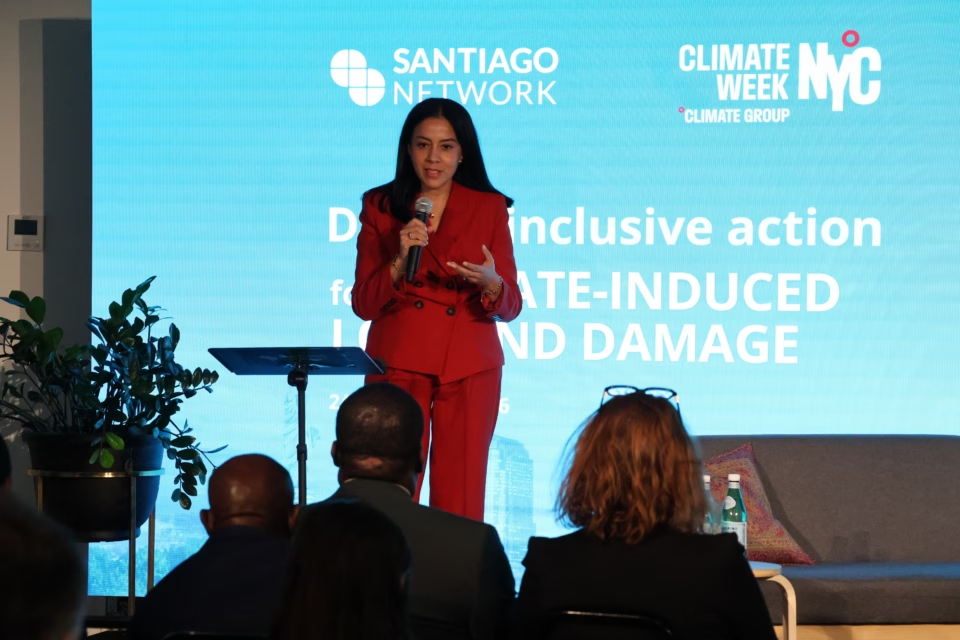
On the margins of Climate Week NYC and the eighty-first session of the United Nations General Assembly (UNGA 81), the Santiago Network engaged with different stakeholders and convened a high-level dialogue on Driving Inclusive Action on Climate-Induced Loss and Damage on 24 September 2026 in New York. The event brought together representatives from governments, organizations, bodies, networks, civil society, academia, international institutions and technical experts to exchange experiences and discuss practical approaches for strengthening support to developing countries particularly vulnerable to the adverse effects of climate change.
Country experiences highlighted the importance of demand-driven support and national priorities alignment
The first panel shared countries' experiences in addressing climate-induced loss and damage and the role of technical assistance in supporting national priorities.
The Minister of Environment of Haiti, Valéry Fils-Aimé, shared Haiti's ambition to establish the foundational elements of a national system for assessing and monitoring climate-related loss and damage (SYNEPP) through technical assistance catalyzed by the Santiago Network. He highlighted how this initiative will support the Government of Haiti's ongoing efforts to strengthen its capacity to assess, monitor, and have reliable data to address climate-induced loss and damage. In his words, “technical assistance will help us move from data to knowledge, from knowledge to decisions, and from decisions to investments.”
Representing the Government of Kenya, Dr Pacifica Ogola emphasized that technical assistance is most effective when it is tailored to national circumstances, priorities and existing capacities. Rather than applying standardized solutions, support should be designed around country-defined needs and informed by local realities. She called for “technical assistance to deliver real and on-the-ground outcomes that respond to urgent local realities.”
As the lead organization of the consortium implementing Kenya's technical assistance through the Santiago Network, Soenke Kreft, Deputy Head of the Risk and Adaptation Department at the United Nations University Institute for Environment and Human Security (UNU-EHS), highlighted key methodological approaches that will be applied in Kenya. These include assessing both economic and non-economic loss and damage across sectors and translating evidence into practical information that can inform policy and decision-making processes. He further emphasized the importance of combining international expertise with local knowledge and community perspectives to ensure that assessments reflect realities on the ground.
Advancing loss and damage action collectively
The second panel focused on advancing collective action and strengthening support across the evolving loss and damage architecture.
Carolina Fuentes Castellanos, Director of the Santiago Network Secretariat, highlighted how the Santiago Network, as an essential component of the broader and evolving loss and damage landscape, works alongside the Executive Committee of the Warsaw International Mechanism, and the funding arrangements, including the Fund for responding to Loss and Damage (FRLD), to catalyze action and support.
She outlined the rapid operational growth of the Santiago Network, with 40 requests for technical assistance to date, up from 20 at the end of 2025, and a network which now comprises more than 400 Members, up from 77 at the end of 2025. The Network also benefits from the engagement of more than 60 National Liaisons nominated by countries and invited other countries to nominate their focal points to the Santiago Network. This growing network enables collective action among a wide range of stakeholders working to avert, minimize, and address climate-induced loss and damage.
Beyond these figures, Ms Fuentes Castellanos stressed that scaling delivery is not only about increasing the volume of support but also about ensuring its quality, relevance, and potential impact. In this regard, National Liaisons play a critical role in ensuring that technical assistance catalyzed through the Santiago Network remains country-driven, aligned with national priorities, responsive to local needs and connected to broader efforts to strengthen resilience and address climate-induced loss and damage.
Complementing these efforts, Mathilde Laurans, Deputy Executive Director of the FRLD, highlighted the importance of designing financial mechanisms that are responsive to country needs and accessible to affected communities. She underscored the need to ensure that financing arrangements evolve in ways that reflect the diverse realities and priorities of developing countries, and stressed that the FRLD and the Santiago Network are linked by design and therefore, have a clear complementarity mandate. She also updated the audience on progress in the operationalization of the Fund and the prospects ahead.
Adrián Martínez Blanco, Director and Founder of La Ruta del Clima, emphasized the critical role played by civil society organizations in ensuring that local voices and community priorities inform loss and damage responses. He highlighted the importance of community-centered approaches that help ensure support reaches those most affected by climate impacts, and provided examples of the work that La Ruta del Clima is helping advance.
Dr Joshua L. DeVincenzo, Assistant Director at the National Center for Disaster Preparedness, Columbia University, stressed that addressing loss and damage effectively requires combining scientific expertise with local and Indigenous knowledge. He acknowledged that communities often possess critical knowledge about climate risks, vulnerabilities and response options. Incorporating these perspectives into assessments, planning processes and decision-making can lead to more effective, equitable and sustainable outcomes.
Strengthening engagements during Climate Week NYC and UNGA 81 to enhance partnerships
During Climate Week NYC and UNGA 81, the Santiago Network delegation, composed of its Director and Communications Manager, Dorcas Mayala Ntumba, increased strategic engagement with partners and stakeholders to advance climate-induced loss and damage on the global agenda.
On 22 September, the delegation participated in meetings on climate adaptation and climate finance aimed at improving coherence, increasing scale and accelerating delivery to support adaptation, resilience and responses to climate-induced loss and damage.
Carolina Fuentes Castellanos also met with Ibrahima Cheikh Diong, Executive Director of the FRLD, to discuss how the Santiago Network and the FRLD can strengthen their collaboration as key pillars of the multilateral loss and damage support architecture, guided by their respective Boards. The discussion focused on strengthening complementarities between technical assistance and finance, helping to ensure a continuum of support for vulnerable developing countries and communities. They both acknowledged the growing demand from developing countries for technical assistance that can help translate access to finance into concrete action to address climate-induced loss and damage.
The Santiago Network delegation also attended the high-level meeting on Climate and the Just Transition to better understand emerging priorities in global climate action and inform preparations for COP 31. The Santiago Network concluded its engagements during UNGA with the participation of its Director in the FRLD high-level side event, hosted by the Government of the Philippines and entitled “Expanding the finance base: The urgent case for scaling loss and damage finance”, held on 25 September.
As demand for technical assistance continues to grow, the Santiago Network remains committed to ensuring that support is country-driven, responsive to national priorities and informed by local realities and knowledge. To meet this growing demand, greater investment in the Network is needed to expand its reach, strengthen its impact and ensure that vulnerable countries and communities can access timely and quality technical assistance.