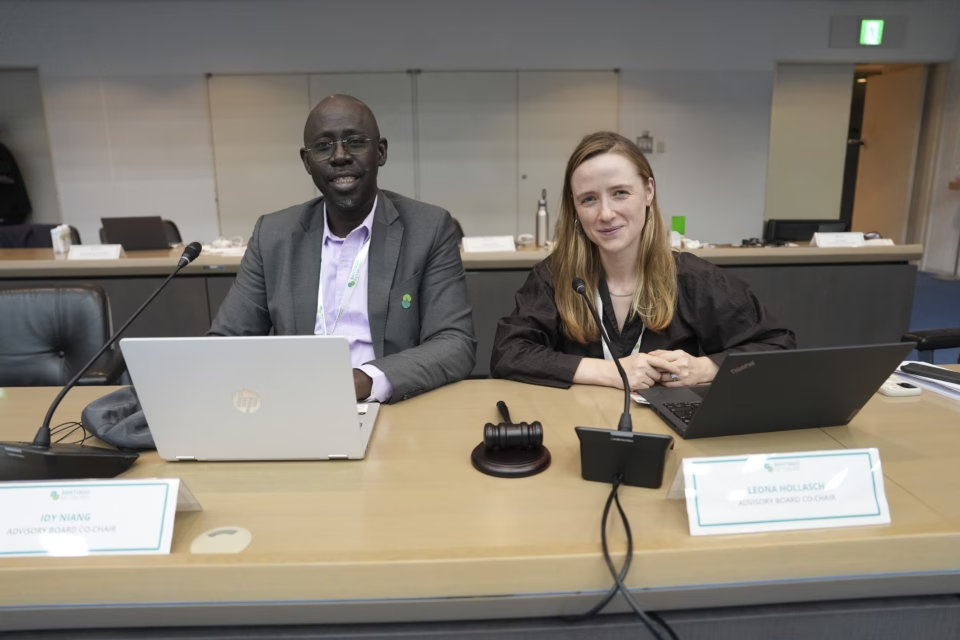
Statement from Co-Chairs on the seventh Advisory Board meeting
We extend our sincere appreciation to the Government of Japan for hosting the seventh meeting of the Santiago Network Advisory Board (SNAB7), marking the first time the Advisory Board has convened outside the Secretariat's headquarters. We express our special thanks to Takeshi Sekiya, Vice-Minister for Global Environmental Affairs, representing the Minister of the Environment, for his inspiring opening remarks, and to the United Nations University for hosting this gathering.
We commend Japan's commitment to advancing global efforts to avert, minimize, and address climate-induced loss and damage and to strengthening the resilience of vulnerable communities, including through early warning systems and partnerships with the private sector.
Since our sixth meeting, the Santiago Network has demonstrated remarkable growth and is starting to create impact, significantly scaling up the delivery of technical assistance, expanding its global membership, and fully operationalizing its Secretariat. In just six months, requests for support have doubled from approximately 20 to 40, including 17 active requests, while membership has grown from around 100 entities to more than 400. Coupled with strengthened institutional capacities across all regions, these achievements position the Network as an increasingly important catalyst in helping developing countries avert, minimize and address climate-induced loss and damage.
This seventh session provided an important opportunity to review and adopt the guidelines on technical assistance and membership with a view to enhancing the Secretariat's efficiency and further improving processes that benefit the countries and communities we serve. The monitoring, evaluation, accountability and learning (MEAL) framework presented by the Secretariat will support evidence-based decision-making and inform future implementation. We encourage the Secretariat to further develop the Santiago Network Gender and Inclusion Action Plan (GIAP), whose zero draft was presented during this meeting, through a participatory stakeholder consultation process.
We strongly believe that the regular report on loss and damage associated with the adverse effects of climate change, for which the terms of reference were adopted at SNAB7, will help strengthen knowledge generation and improve understanding of evolving loss and damage challenges globally.
The decisions taken during this meeting will support the establishment of a strategic framework for monitoring results and drawing on lessons learned as the Network expands its operations. The Network has already launched activities in four countries, namely the Cook Islands, Kenya, Namibia and Yemen. The diverse profiles of the organizations, bodies, networks and experts involved, including United Nations entities, research institutions, local and women's organizations, and individual experts, reflect the Network's commitment to diversity and inclusiveness. Efforts to strengthen the Network's global positioning have remained a priority, with active participation at SB 64, a strong presence during the eighty-first session of the United Nations General Assembly (UNGA 81) and Climate Week NYC through a flagship event, and engagement in high-level discussions on climate action, resilience, adaptation and climate finance.
— Idy Niang and Leona Hollasch, Co-Chairs of the Santiago Network Advisory Board